Parking Meters and Tickets
- The first parking meter was a nickel an hour. The first "Park-O-Meter" was installed in Oklahoma City on July 16, 1935. It was invented by newspaper editor Carl Magee.
- Britain's first meters arrived in 1958. They appeared in London's Mayfair, and traffic wardens followed in 1960 to enforce them.
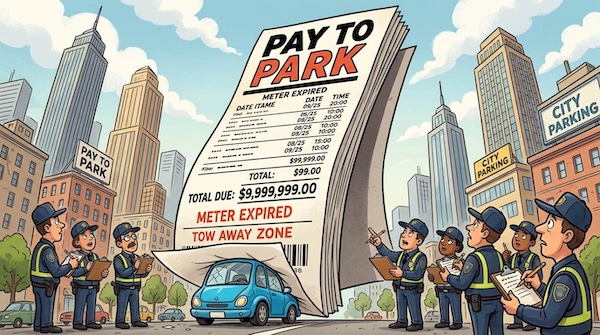
- Big cities hand out millions of tickets a year. New York City issues roughly ten million parking tickets annually, making it one of the biggest ticket-writing operations in the world.
- Fire hydrants have a no-parking buffer. Most US states prohibit parking within about 15 feet of a hydrant so crews can connect hoses quickly.
- Hill parking has a rule. Facing downhill, turn your wheels toward the curb; facing uphill with a curb, turn them away from it. If the car rolls, the curb stops it.
- Alternate side parking keeps streets clean. Cities like New York move cars on set days so street sweepers can reach the gutters, and the rules are often suspended on holidays.
The Real Cost of Parking
- Cars sit parked about 95% of the time. This widely cited figure comes from UK research, and it means the average car is on the move only a tiny slice of its life.
- Free parking isn't free. Economist Donald Shoup's book The High Cost of Free Parking (2005) argued that "free" spaces are paid for through higher prices, rents and taxes.
- Hunting for a spot burns real fuel. Shoup's study of a Los Angeles business district estimated drivers cruising for parking logged around 950,000 extra miles in a year.
- Cruising can be a big share of downtown traffic. Studies across cities have found anywhere from a few percent to around a third of downtown traffic is people looking for a space.
- A single parking space can cost six or seven figures. Spaces in Hong Kong have sold for close to US$1 million, and a Boston Back Bay space has sold for more than half a million dollars.
- Building a garage space is expensive. In many US cities, a structured parking space costs tens of thousands of dollars to build, and underground spaces cost even more.
- Airports often earn more from parking than from anything else non-flight. For many airports, parking is the largest single source of revenue outside of airline fees.
- Surge pricing came to parking. San Francisco's SFpark program adjusted meter prices by block and time of day to keep roughly one space open per block.
Space, Size and Land
- A typical US space is about 9 by 18 feet. Widths of 8.5 to 9 feet and lengths of 18 to 20 feet are common, though local codes vary.
- European spaces are often a bit smaller. A common size is about 2.3 to 2.5 metres wide and around 5 metres long.
- Los Angeles County has an enormous parking supply. One research study counted roughly 18.6 million spaces, covering a significant share of the developed land.
- Parking lots are sized for the busiest days. Retail lots are often built to handle peak shopping days, which is why they look empty most of the year.
- Mall of America has more than 12,000 spaces. It's one of the largest parking supplies at a single shopping centre in the US.
- Parking lots run hot. Dark asphalt absorbs sunlight and gets far hotter than the air around it, which adds to the urban heat island effect.
- 90-degree spaces fit more cars, angled spaces are easier. Perpendicular bays squeeze in the most cars, while angled bays let drivers pull in more easily and keep traffic one-way.
- Accessible spaces have required dimensions. After the Americans with Disabilities Act of 1990, US standards call for accessible spaces with an adjacent access aisle, and van-accessible spaces are wider.
Parking Around the World
- In Japan, you must prove you have a parking space to buy a car. The "shako shomeisho" certificate is required in most of the country before registering a vehicle.
- Paris voted to charge heavy SUVs more. In February 2024, Paris voters backed higher parking rates for large, heavy vehicles visiting the city.
- Buffalo dropped its parking minimums. In 2017, Buffalo, New York became the first major US city to eliminate citywide minimum parking requirements for new development.
- Boston and Chicago have "parking chairs." After a snowstorm, residents place chairs and cones in cleared spaces to claim them, a custom that's controversial but long-running. Pittsburgh has its own "Parking Chair" tradition.
- Robotic garages park the car for you. Automated systems lift and shuttle cars into tight racks, fitting more vehicles into less space because no one needs to open a door or walk.
- Many European old towns limit cars entirely. Residents-only zones and car-free centres mean visitors often use park-and-ride lots on the edge of town.
Cars, Tech and Culture
- Self-parking cars are older than you think. Toyota's Intelligent Parking Assist debuted on the Prius in Japan in 2003.
- PARK(ing) Day turns spaces into parks. Started in San Francisco in 2005 by the design studio Rebar, people feed a meter and turn a single space into a tiny park, and it's now held around the world each September.
- Valet parking is a service with deep roots. Valet parking became popular in the early days of car culture, and today it's standard at hotels, restaurants and event venues.
- Parallel parking is a driving-test classic. It's part of the driving exam in many US states, and a common reason test-takers lose points.
- Electric vehicles are changing lots. Many new garages and lots now reserve spaces with chargers, and ticketing for blocking an EV space is increasingly common.
- Pay-by-phone is replacing coins. Many cities now accept parking payment through apps, so drivers can extend a session without returning to the car.
- Plate-recognition cameras are everywhere. Many garages and enforcement vehicles read license plates automatically, so tickets and gates can work without a paper stub.
- Parking signs can be confusing. Stacked signs with different hours and exceptions are common enough that some cities have redesigned them to be easier to read.
- Most trips end with a parked car. Every car trip needs a space at both ends, so one car often needs several spaces: home, work and the shops.
- Reserving ahead can save money. Booking a spot online near an airport, stadium or downtown venue is often cheaper than paying the drive-up rate.
- Parking rules vary block by block. A space that's legal at 9 a.m. can be a tow-away zone at 4 p.m., so always read the sign.
- Planners aim for "mostly full, never packed." Shoup's well-known rule of thumb is to price curb parking so that about 85% of spaces are occupied, leaving a few open on every block.
Figures such as space counts, ticket volumes and prices are approximate and change over time. Always check local rules and current rates before you park.
Want to Save on Parking?
Browse the PayToPark.net directory to find and compare parking near you.
Powered by PayToPark
Parking Facts is made possible by PayToPark.net and the PayToPark App
Find, compare and pay for parking on the web at PayToPark.net or on the go with the PayToPark App.